Control Plane Resilience: Handling Cascading Failures in Distributed Orchestration
Building fault-tolerant control planes with circuit breakers, graceful degradation, and bulkheads to prevent cascading failures in distributed workload orchestration systems.
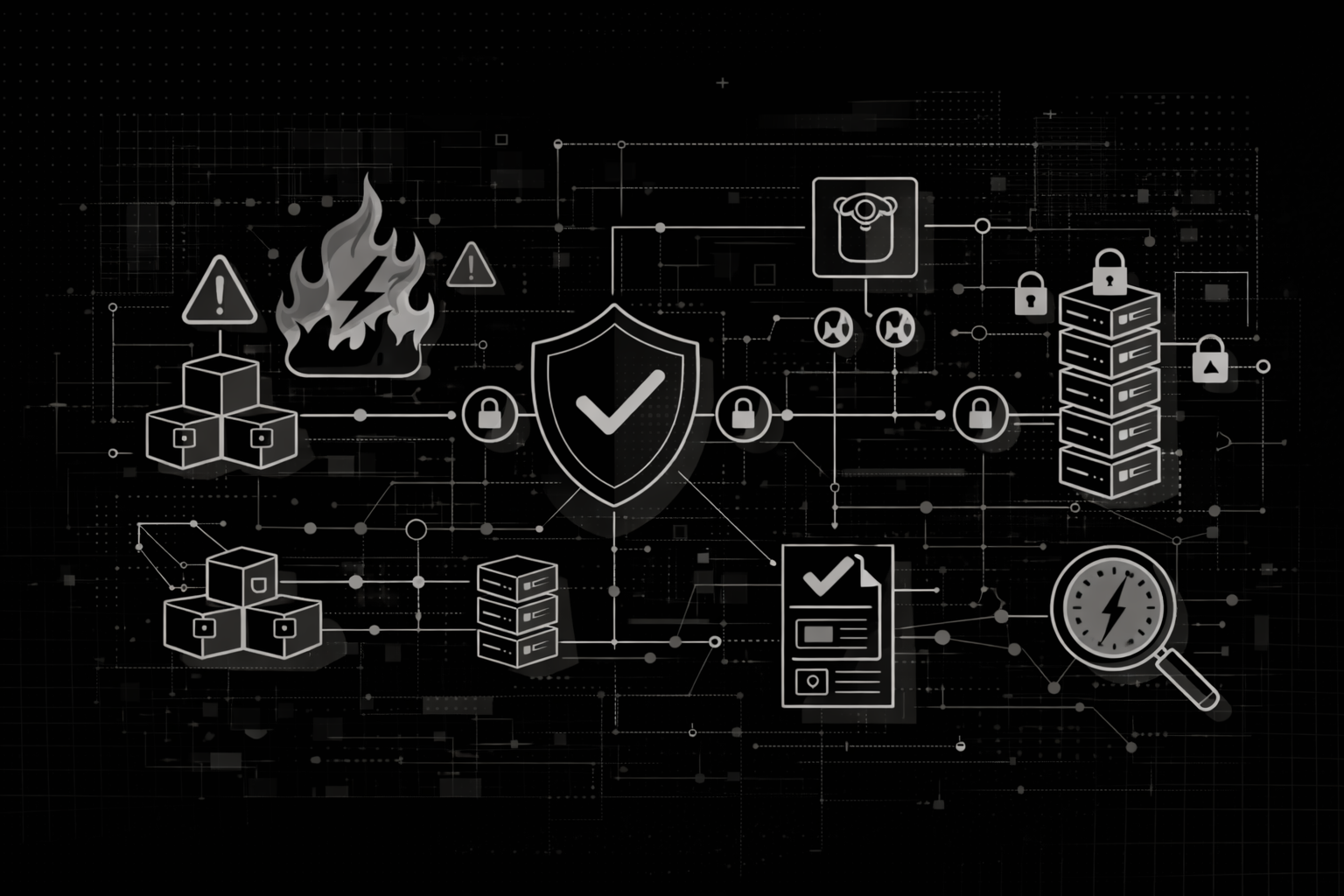
Series: Secure Workload Orchestration
- Part 1Building a Polymorphic Workload Orchestrator with Go and Kubernetes
- Part 2Hardening the Control Plane: From Pods to MicroVMs
- Part 3Zero-Trust Networking for AI Agents: Protecting Your Internal VPC
- Part 4Enterprise Audit Logging and Monitoring: The Missing Piece of the Control Plane
- Part 5Control Plane Resilience: Handling Cascading Failures in Distributed Orchestration
In the previous parts of this series, we built a production-grade workload orchestration platform with polymorphic runtimes, hardware isolation, zero-trust networking, and comprehensive audit logging.
But there's a critical gap: What happens when things fail?
In distributed systems, failures are not exceptional, they're inevitable. A single slow database query can cascade into a complete platform outage. A Kubernetes API server hiccup can block thousands of workload provisions. A Redis connection timeout can deadlock your entire control plane.
In this final part, we'll implement Resilience Patterns to ensure our control plane degrades gracefully under failure conditions rather than collapsing catastrophically.
The Problem: Cascading Failures
Consider this scenario:
- ClickHouse (our audit sink) becomes slow due to a large query.
- Our audit middleware blocks waiting for writes to complete.
- The worker goroutines pile up, exhausting memory.
- The Go process OOMs and crashes.
- All workload provisioning stops, even though Kubernetes is healthy.
A single component failure took down the entire platform. This is a cascading failure.
The Solution: Defense in Depth
We'll implement three complementary patterns:
- Circuit Breakers: Stop calling failing dependencies.
- Bulkheads: Isolate failures to prevent contagion.
- Graceful Degradation: Continue core operations when non-critical systems fail.
Pattern 1: Circuit Breakers
A circuit breaker wraps external calls and "opens" (stops calling) when a dependency fails repeatedly. This prevents wasting resources on doomed requests.
The Circuit Breaker Interface
go
package resilience

import (
    "context"
    "errors"
    "sync"
    "time"
)

var ErrCircuitOpen = errors.New("circuit breaker is open")

type State int

const (
    StateClosed State = iota // Normal operation
    StateOpen                 // Failing, reject requests
    StateHalfOpen            // Testing if service recovered
)

type CircuitBreaker struct {
    maxFailures  uint32
    resetTimeout time.Duration

    mu           sync.RWMutex
    state        State
    failures     uint32
    lastFailTime time.Time
}

func NewCircuitBreaker(maxFailures uint32, resetTimeout time.Duration) *CircuitBreaker {
    return &CircuitBreaker{
        maxFailures:  maxFailures,
        resetTimeout: resetTimeout,
        state:        StateClosed,
    }
}

func (cb *CircuitBreaker) Execute(ctx context.Context, fn func() error) error {
    // Check if we should attempt the call
    if !cb.canAttempt() {
        return ErrCircuitOpen
    }

    // Execute the function
    err := fn()

    // Record the result
    cb.recordResult(err)

    return err
}

func (cb *CircuitBreaker) canAttempt() bool {
    cb.mu.RLock()
    defer cb.mu.RUnlock()

    switch cb.state {
    case StateClosed:
        return true
    case StateOpen:
        // Check if enough time has passed to try again
        if time.Since(cb.lastFailTime) > cb.resetTimeout {
            cb.mu.RUnlock()
            cb.mu.Lock()
            cb.state = StateHalfOpen
            cb.mu.Unlock()
            cb.mu.RLock()
            return true
        }
        return false
    case StateHalfOpen:
        return true
    default:
        return false
    }
}

func (cb *CircuitBreaker) recordResult(err error) {
    cb.mu.Lock()
    defer cb.mu.Unlock()

    if err == nil {
        // Success! Reset the circuit
        if cb.state == StateHalfOpen {
            cb.state = StateClosed
        }
        cb.failures = 0
        return
    }

    // Failure
    cb.failures++
    cb.lastFailTime = time.Now()

    if cb.failures >= cb.maxFailures {
        cb.state = StateOpen
    }
}

func (cb *CircuitBreaker) GetState() State {
    cb.mu.RLock()
    defer cb.mu.RUnlock()
    return cb.state
}
Protecting the Audit Sink
We wrap our ClickHouse/Kafka writes with a circuit breaker:
go
package middleware

import (
    "context"
    "log"
    "time"
)

type ResilientAuditSink struct {
    underlying AuditSink
    breaker    *resilience.CircuitBreaker
    fallback   AuditSink // Local file or memory buffer
}

func NewResilientAuditSink(sink AuditSink, fallback AuditSink) *ResilientAuditSink {
    return &ResilientAuditSink{
        underlying: sink,
        fallback:   fallback,
        breaker:    resilience.NewCircuitBreaker(5, 30*time.Second),
    }
}

func (r *ResilientAuditSink) Write(entry AuditEntry) {
    // Try the primary sink with circuit breaker protection
    err := r.breaker.Execute(context.Background(), func() error {
        return r.underlying.Write(entry)
    })

    if err == resilience.ErrCircuitOpen {
        log.Printf("⚠️  Audit circuit open, using fallback for %s", entry.WorkloadID)
        // Write to local buffer instead
        r.fallback.Write(entry)
        return
    }

    if err != nil {
        log.Printf("❌ Audit write failed: %v", err)
        // Also use fallback on regular errors
        r.fallback.Write(entry)
    }
}
Now, if ClickHouse becomes slow or unavailable, we:
- Detect the failure after 5 consecutive errors.
- Stop sending traffic for 30 seconds (preventing pile-up).
- Write to a local fallback (file or in-memory buffer).
- Automatically retry after the timeout.
The fallback sink can be a local file that gets replayed later, or an in-memory ring buffer. For critical audit logs, consider a durable local queue like BoltDB or SQLite that syncs back when the primary recovers.
Pattern 2: Bulkheads
In ship design, bulkheads are compartments that prevent a single hull breach from sinking the entire vessel. In software, we use resource isolation to prevent one failing component from exhausting shared resources.
The Problem: Shared Worker Pool
Our current design uses a single Redis queue and unlimited goroutines:
go
func (w *Worker) Start(ctx context.Context) {
    for {
        task := w.redis.BRPop(ctx, 0, "workload_queue")
        go w.handleTask(ctx, runtime, task) // UNBOUNDED!
    }
}
If handleTask blocks (e.g., waiting for a slow Kubernetes API), we spawn infinite goroutines and exhaust memory.
The Solution: Bounded Worker Pools
We create separate, bounded pools for different workload types:
go
package worker

import (
    "context"
    "log"
)

type BulkheadWorker struct {
    trustedPool   *WorkerPool
    untrustedPool *WorkerPool
    redis         *redis.Client
}

type WorkerPool struct {
    name     string
    size     int
    taskChan chan Task
    runtime  runtime.WorkloadRuntime
}

func NewWorkerPool(name string, size int, runtime runtime.WorkloadRuntime) *WorkerPool {
    pool := &WorkerPool{
        name:     name,
        size:     size,
        taskChan: make(chan Task, size*2), // Buffered channel
        runtime:  runtime,
    }

    // Start fixed number of workers
    for i := 0; i < size; i++ {
        go pool.worker(i)
    }

    return pool
}

func (p *WorkerPool) worker(id int) {
    log.Printf("🔧 Worker %s-%d started", p.name, id)

    for task := range p.taskChan {
        log.Printf("⚙️  Worker %s-%d processing %s", p.name, id, task.ID)

        // Execute with timeout to prevent infinite blocking
        ctx, cancel := context.WithTimeout(context.Background(), 5*time.Minute)

        err := p.runtime.Provision(ctx, task.ID, task.Spec)
        if err != nil {
            log.Printf("❌ Worker %s-%d failed task %s: %v", p.name, id, task.ID, err)
        }

        cancel()
    }
}

func (p *WorkerPool) Submit(task Task) bool {
    select {
    case p.taskChan <- task:
        return true
    default:
        // Pool is full, reject the task
        log.Printf("⚠️  Pool %s is full, rejecting task %s", p.name, task.ID)
        return false
    }
}

func (w *BulkheadWorker) Start(ctx context.Context) {
    // Create isolated pools
    w.trustedPool = NewWorkerPool("trusted", 10, w.trustedRuntime)
    w.untrustedPool = NewWorkerPool("untrusted", 5, w.untrustedRuntime)

    for {
        result, err := w.redis.BRPop(ctx, 0, "workload_queue").Result()
        if err != nil {
            continue
        }

        var task Task
        json.Unmarshal([]byte(result[1]), &task)

        // Route to appropriate pool
        var accepted bool
        if task.Type == "untrusted" {
            accepted = w.untrustedPool.Submit(task)
        } else {
            accepted = w.trustedPool.Submit(task)
        }

        if !accepted {
            // Pool is saturated, push back to Redis with delay
            w.redis.LPush(ctx, "workload_queue_retry", result[1])
        }
    }
}
Benefits of Bulkheads
- Resource Isolation: Untrusted workloads can't exhaust resources for trusted ones.
- Bounded Memory: Fixed goroutine count prevents OOM.
- Backpressure: When pools are full, we reject or delay new work instead of crashing.
Pattern 3: Graceful Degradation
Not all failures are equal. If audit logging fails, we should continue provisioning workloads. If Kubernetes fails, we must stop everything.
Criticality Levels
We categorize dependencies:
go
type Criticality int

const (
    CriticalityOptional Criticality = iota // Logging, metrics
    CriticalityDegraded                    // Partial functionality
    CriticalityCritical                    // Must work or fail
)

type Dependency struct {
    Name        string
    Criticality Criticality
    HealthCheck func(context.Context) error
    Breaker     *resilience.CircuitBreaker
}
Health-Aware Middleware
We extend our audit middleware to degrade gracefully:
go
type GracefulAuditMiddleware struct {
    Next        runtime.WorkloadRuntime
    Sink        *ResilientAuditSink
    degraded    atomic.Bool
}

func (g *GracefulAuditMiddleware) Provision(ctx context.Context, id string, spec runtime.Spec) error {
    // ALWAYS provision the workload (critical path)
    err := g.Next.Provision(ctx, id, spec)

    // BEST EFFORT audit logging (non-critical)
    if !g.degraded.Load() {
        entry := g.buildAuditEntry(id, spec, err)

        // Fire and forget - don't block on logging
        go func() {
            auditErr := g.Sink.Write(entry)
            if auditErr != nil {
                // Enter degraded mode
                g.degraded.Store(true)
                log.Printf("⚠️  Entering degraded mode: audit logging disabled")
            }
        }()
    }

    return err // Return the ACTUAL provision error, not audit error
}
System Health Endpoint
Expose overall system health for load balancers and monitoring:
go
type HealthStatus struct {
    Status       string                 `json:"status"` // "healthy", "degraded", "critical"
    Dependencies map[string]DepHealth   `json:"dependencies"`
    Timestamp    time.Time              `json:"timestamp"`
}

type DepHealth struct {
    Status      string `json:"status"`
    Criticality string `json:"criticality"`
    Message     string `json:"message,omitempty"`
}

func (w *Worker) HealthCheck(ctx context.Context) HealthStatus {
    status := HealthStatus{
        Status:       "healthy",
        Dependencies: make(map[string]DepHealth),
        Timestamp:    time.Now(),
    }

    // Check Kubernetes
    k8sErr := w.k8sRuntime.HealthCheck(ctx)
    if k8sErr != nil {
        status.Status = "critical"
        status.Dependencies["kubernetes"] = DepHealth{
            Status:      "unhealthy",
            Criticality: "critical",
            Message:     k8sErr.Error(),
        }
    } else {
        status.Dependencies["kubernetes"] = DepHealth{
            Status:      "healthy",
            Criticality: "critical",
        }
    }

    // Check ClickHouse (non-critical)
    if w.auditSink.breaker.GetState() == resilience.StateOpen {
        status.Status = "degraded"
        status.Dependencies["clickhouse"] = DepHealth{
            Status:      "unhealthy",
            Criticality: "optional",
            Message:     "circuit breaker open",
        }
    } else {
        status.Dependencies["clickhouse"] = DepHealth{
            Status:      "healthy",
            Criticality: "optional",
        }
    }

    return status
}
Timeout Propagation
Every external call needs a timeout. We use context deadlines throughout:
go
func (w *Worker) handleTask(ctx context.Context, runtime runtime.WorkloadRuntime, task Task) {
    // Set overall task timeout
    ctx, cancel := context.WithTimeout(ctx, 5*time.Minute)
    defer cancel()

    // Provision with timeout
    err := runtime.Provision(ctx, task.ID, task.Spec)
    if err != nil {
        if errors.Is(err, context.DeadlineExceeded) {
            log.Printf("⏱️  Task %s timed out after 5 minutes", task.ID)
            // Cleanup partial resources
            runtime.Teardown(context.Background(), task.ID)
        }
        return
    }

    // Wait for completion with timeout
    ticker := time.NewTicker(10 * time.Second)
    defer ticker.Stop()

    for {
        select {
        case <-ctx.Done():
            log.Printf("⏱️  Task %s monitoring timed out", task.ID)
            return
        case <-ticker.C:
            status, err := runtime.Status(ctx, task.ID)
            if err != nil || status.Phase == "Completed" {
                return
            }
        }
    }
}
Monitoring Resilience Metrics
Expose circuit breaker states and pool saturation as Prometheus metrics:
go
var (
    circuitBreakerState = prometheus.NewGaugeVec(
        prometheus.GaugeOpts{
            Name: "control_plane_circuit_breaker_state",
            Help: "Circuit breaker state (0=closed, 1=open, 2=half-open)",
        },
        []string{"dependency"},
    )

    workerPoolUtilization = prometheus.NewGaugeVec(
        prometheus.GaugeOpts{
            Name: "control_plane_worker_pool_utilization",
            Help: "Worker pool utilization (0-1)",
        },
        []string{"pool_name"},
    )

    degradedMode = prometheus.NewGauge(
        prometheus.GaugeOpts{
            Name: "control_plane_degraded_mode",
            Help: "Whether the control plane is in degraded mode (0=healthy, 1=degraded)",
        },
    )
)

func (w *Worker) recordMetrics() {
    // Update circuit breaker metrics
    circuitBreakerState.WithLabelValues("clickhouse").Set(
        float64(w.auditSink.breaker.GetState()),
    )

    // Update pool utilization
    trustedUtil := float64(len(w.trustedPool.taskChan)) / float64(cap(w.trustedPool.taskChan))
    workerPoolUtilization.WithLabelValues("trusted").Set(trustedUtil)

    untrustedUtil := float64(len(w.untrustedPool.taskChan)) / float64(cap(w.untrustedPool.taskChan))
    workerPoolUtilization.WithLabelValues("untrusted").Set(untrustedUtil)

    // Update degraded mode
    if w.auditMiddleware.degraded.Load() {
        degradedMode.Set(1)
    } else {
        degradedMode.Set(0)
    }
}
Testing Resilience
Chaos engineering is critical. Test your resilience patterns:
$> # 1. Simulate ClickHouse failure
kubectl scale deployment clickhouse --replicas=0

# 2. Verify control plane continues provisioning
kubectl logs -f -l app=orchestrator | grep "Entering degraded mode"

# 3. Verify fallback logging
kubectl exec -it orchestrator-pod -- ls /var/log/audit-fallback/

# 4. Simulate Kubernetes API slowness
# Use a network policy to add 5s latency to kube-apiserver
tc qdisc add dev eth0 root netem delay 5000ms

# 5. Verify worker pool backpressure
# Should see "Pool full, rejecting task" messages

# 6. Restore services
kubectl scale deployment clickhouse --replicas=1
tc qdisc del dev eth0 root
Deployment Configuration
Update the orchestrator deployment with resource limits and health checks:
manifests/deployment.yaml
apiVersion: apps/v1
kind: Deployment
metadata:
  name: orchestrator
spec:
  replicas: 3 # Multiple replicas for HA
  template:
    spec:
      containers:
        - name: manager
          image: astraq/orchestrator:v2
          resources:
            requests:
              cpu: "500m"
              memory: "512Mi"
            limits:
              cpu: "2000m"
              memory: "2Gi"
          livenessProbe:
            httpGet:
              path: /health
              port: 8080
            initialDelaySeconds: 30
            periodSeconds: 10
            timeoutSeconds: 5
            failureThreshold: 3
          readinessProbe:
            httpGet:
              path: /ready
              port: 8080
            initialDelaySeconds: 10
            periodSeconds: 5
            timeoutSeconds: 3
          env:
            - name: WORKER_POOL_TRUSTED_SIZE
              value: "10"
            - name: WORKER_POOL_UNTRUSTED_SIZE
              value: "5"
            - name: CIRCUIT_BREAKER_THRESHOLD
              value: "5"
            - name: CIRCUIT_BREAKER_TIMEOUT
              value: "30s"
Conclusion
We've transformed our control plane from a brittle prototype into a resilient production system:
- Circuit Breakers: Prevent cascading failures by stopping calls to failing dependencies.
- Bulkheads: Isolate resource pools to prevent contagion between workload types.
- Graceful Degradation: Continue core operations even when non-critical systems fail.
- Timeout Propagation: Prevent infinite blocking with context deadlines.
- Health Monitoring: Expose system health for observability and load balancing.
This is the difference between a system that "works in testing" and one that survives production.
Our platform can now handle:
- ClickHouse outages (falls back to local logging)
- Kubernetes API slowness (bounded worker pools prevent pile-up)
- Redis connection failures (circuit breakers prevent retry storms)
- Partial network failures (timeouts prevent deadlocks)
Combined with the security, isolation, and observability from previous parts, we've built a production-grade workload orchestration platform that can safely run untrusted AI agents at scale.